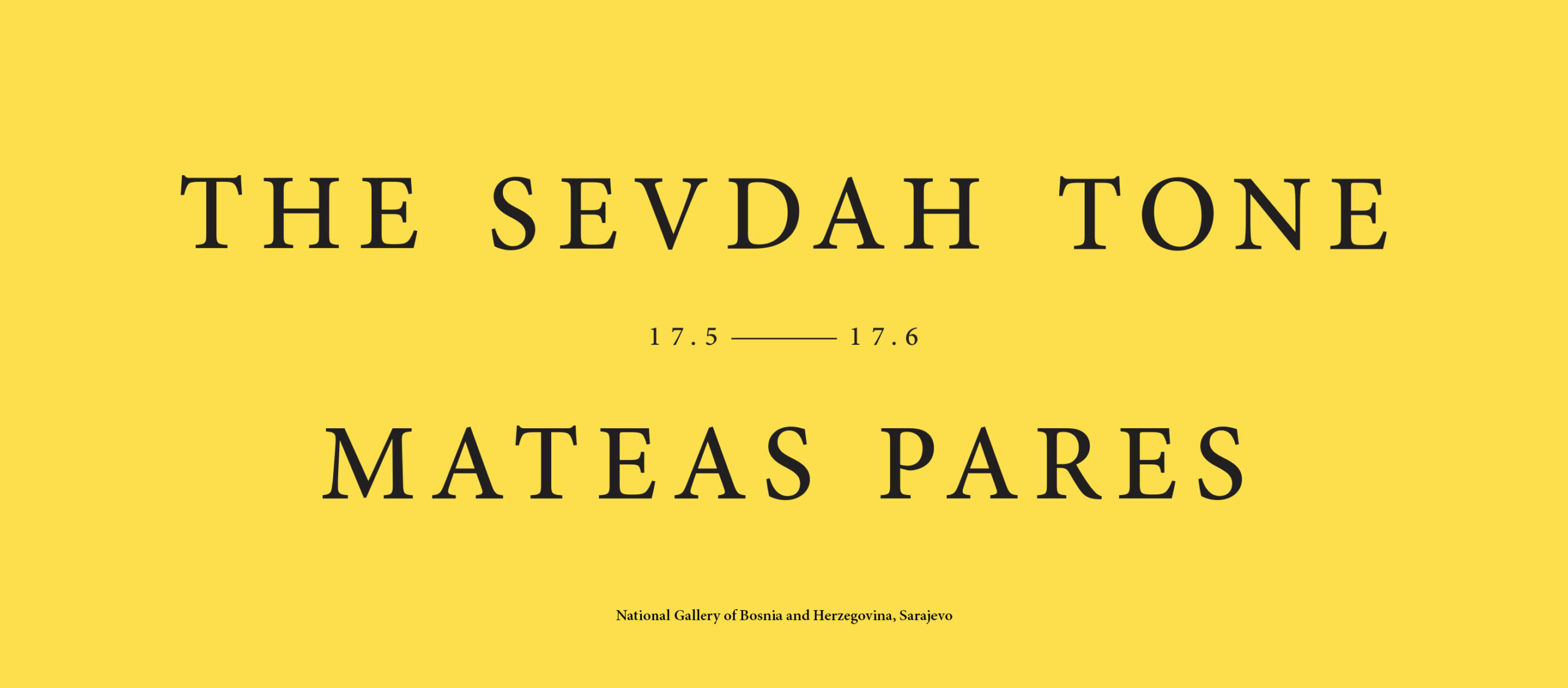
Mateas Pares
The Sevdah Tone
May 17 – June 17, 2022
“The Sevdah Tone is the result of the failed attempt to go to Sarajevo for a week in the late summer of 2020 and gain enough knowledge of the war in former Yugoslavia in the first half of the 1990s, to understand what effects a conflict can have on identity — on an individual level as well as on a societal level — after it has been overcome. The aim was ultimately to create an art project of it. For the project I used the definition of conflict from works of narrative, such as books and films, where conflict means the challenge the protagonist needs to solve in order to achieve his or her goal, and move forward. Since conflicts seem to be interweaved with our history, I was curious to understand if, why, and how, we too, seem to need the conflict in order to move forward. Before departing to Sarajevo I listed a number of questions that were going to serve as tools for gathering the information that I needed: what had happened; why had it happen; how was it overcome; how do people relate to it today; how had it changed their identity; what are the negative as well as the positive effects; and so forth. As many years had passed since its ending and it had therefore been well studied, at the same time as it was still fresh in the mind of the majority of the citizens, it seemed to be the perfect soil for this subject; a perfect case study to build my project on.
Although, what soon became apparent after just a few days was the fact that a case study did not exist, and I was not standing on soil but on mud. The more people I talked and listened to, the more I realized that one simple truth did not exist, but instead what existed was an immeasurable number of contradictory truths. The reason, I learned, was that contrary to my belief the conflict was not over, it had merely changed appearance. The sounds of sniper bullets hitting flesh, and the images of limbs covering the streets had simply been replaced by a combination of a suppressing of the past, and individuals and groups arguing over the war’s historiography. The paths to create their post-war identities were corrupted by truths and lies seemlessly intertwined by ignorance, self-deception, and dishonesty.
Returning to my hotel room every evening, summarizing my daily experiences and notes, I also started to realize my own naivety to think that I would be able to, in just one week, reach such level of knowledge that I could make this project in a well-informed way. The more I realized that I was only scratching the surface, the more I felt like a tourist. The intellectual depth of the knowledge I amassed could be compared to the photos visitors take of the exotified details of Sarajevo: the bullet holes still covering the facades; the Sarajevo roses; or of the hills surrounding the city where the Army of Republika Srpska was located during the siege. I noticed that as a consequence of my frustration to being stuck with my own, the situation’s, as well as the country’s, inability to serve the aim of my project, I started to force my preconceived beliefs into the reality I faced, rather than reconsidering and readjusting my beliefs to better align with the new facts which I was confronted with. To create and maintain my identity as a certain artist, I corrupted my own path with truths and lies seemlessly intertwined by my very own ignorance, self-deception, and dishonesty.
On the plane back to Stockholm, I had no choice but to admit to myself that I had failed miserably. Not only did I not have a project, I also realized that this was most certainly not a one time occurance, but all of my previous projects, as well as my entire being, most certainly were corrupted too. From the ashes of the failure, a new question, forming a new project, emerged: If our identity is built on a set of beliefs, and these beliefs are built on what we think are facts about reality, but what they really are, are products of inevitable conscious or unconscious distortions of reality, how do we move forward as protagonists in our own narratives, when we realize that we will never reach an absolute truth, ultimately being forced to live with identities built on our own made up reality?”
Mateas Pares (23 August 2020, Stockholm)
Biography
Mateas Pares studied graphic design and commercial arts at Beckmans College of Design and Bergh’s School of Communication and moved abroad shortly thereafter. Working and living in London, Amsterdam, Paris, Hong Kong, and Stockholm, he has won numerous awards for his work, including Cannes Grand Prix. In 2012, Pares began working full time to develop his art. In addition to his art practice he also runs the exhibition project StudyForArtPlatform in Stockholm. Besides “The Sevdah Tone”, future exhibitions include a duo exhibition during the Venice biennale, and a solo show in Stockholm.